📅 August 24, 2026
Hull Punished United’s Set Pieces. Ipswich Punish Turnovers. Sunday Needs Both Fixed
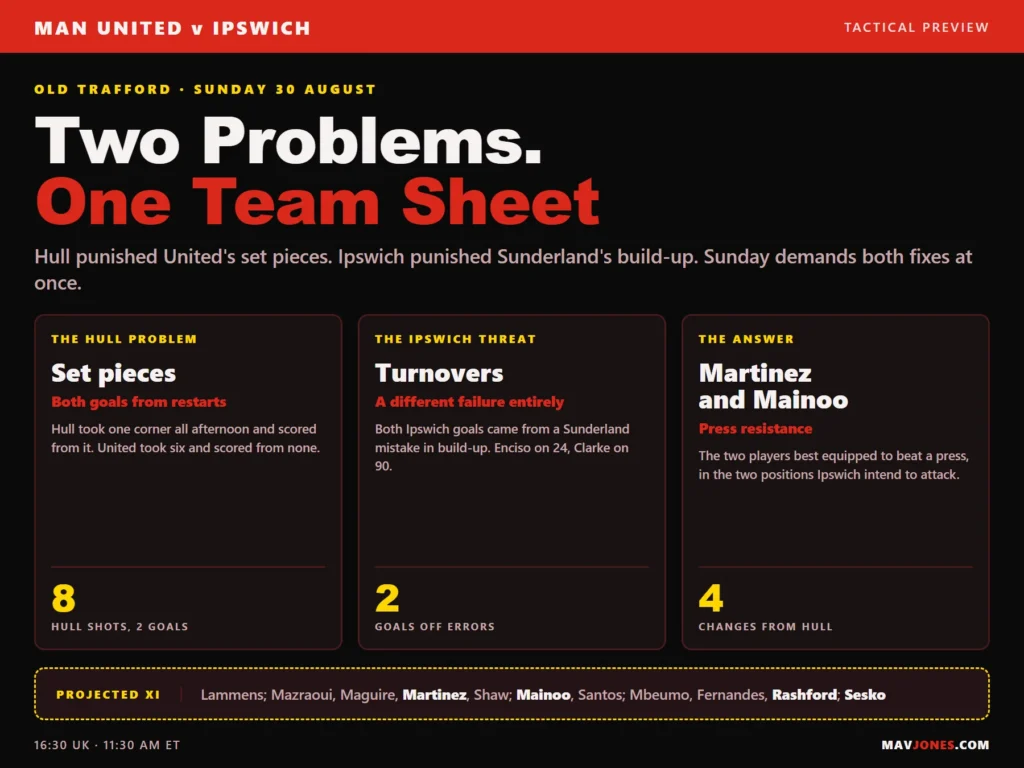
Hull beat United at set pieces. Ipswich beat Sunderland at turnovers. Those are two different problems, they arrived on the same afternoon, and United have seven days to solve both.
The good news is that one selection goes a long way to answering them. The bad news is that it depends on a thigh.
Both goals came from the same phase, and neither was a marking mismatch
On 17 minutes Regan Slater drove a corner in. Oli McBurnie got away from his marker to meet it, Senne Lammens pushed the effort onto the far post, and Semi Ajayi followed it in to poke home the rebound. Two failures in one phase: the man attacking the ball was not picked up, and nobody accounted for the second one.
On 38 minutes Slater whipped in a free-kick, won off Youri Tielemans, and Nobel Mendy headed it past Lammens on his debut.
Hull took eight shots all afternoon and scored from the two that started as dead balls. Their only corner of the match produced a goal. United took six and scored from none.
This is not a United eccentricity. Non-penalty set pieces accounted for 27.4% of Premier League goals last season, the second-highest share in 34 seasons, up from 20.6%. Goals from corners reached 18%, an all-time high, up from 12.1%. Fifteen of the twenty clubs now employ a specialist set-piece coach, and Arsenal have built a title challenge on what Nicolas Jover does with corners. Every promoted side in the league knows the margin is there.
Hull’s plan was to make United play in front of them
The possession figure is misleading, and the clock is most of the reason. Hull led inside 17 minutes and were two up by 38. Almost all of United’s 72% came with the game already gone, against a side with every reason to sit in and none at all to chase it.
They defended in a 5-4-1 and let United have the ball wherever it did least damage. Hull made 55 clearances to United’s 17. United completed 574 passes at 88% accuracy, Hull 177 at 70%, and Hull won 50 duels to United’s 35. Eight of United’s 21 shots were blocked.
Those numbers describe a team going through the front of a block rather than moving it first. A low block has one structural weakness, which is that compactness can only be held in one place at a time. Overload a flank properly and the defending side has to choose between shifting across and vacating the middle, or holding and conceding the numbers wide. United never forced that choice often enough, and 1.81 expected goals against Hull’s 1.26 says they got close anyway.
Ipswich will not defend like that, and that changes everything
Gary O’Neil’s first competitive team selection included seven new signings, and they won 2-1 at Portman Road.
Both Ipswich goals came from a Sunderland mistake in build-up. On 24 minutes Julio Enciso intercepted a poor pass from Luke O’Nien and squared it for Emersonn. On 90 minutes Jack Clarke, on from the bench against his former club, took advantage of a slack ball from Omar Alderete and finished from 20 yards. Sunderland’s equaliser, a Nilson Angulo free-kick from 25 yards, was the only goal in the match that came from a set piece rather than a turnover.
That is a coherent identity, not a fluke. Ipswich pressed aggressively without the ball, committed bodies forward, and attacked in direct transitions. In pre-season they beat Rayo Vallecano 3-0 and won 4-2 away at Union Berlin. This is a promoted side that intends to score.
Which is why the fixture is a better opportunity than the table suggests, and a more specific threat than the scoreline at Hull implies. A team that presses cannot also sit in a 5-4-1 for ninety minutes. Every yard Ipswich come up the pitch is a yard behind them. But a team that presses will punish exactly the thing Hull never bothered to attack, which is United’s centre-backs receiving the ball with a man closing.
The centre-back choice answers both questions at once
United started Harry Maguire and Ayden Heaven at Hull. Against a side whose entire plan was aerial delivery, that pairing conceded twice from restarts. Against a side whose plan is to press the first pass, it carries a different risk: Heaven is nineteen and making his way, and Maguire has never been the man you want turning out of pressure on the halfway line.
Lisandro Martinez is the obvious answer to the second problem. He is the most press-resistant passer in the squad, and the one centre-back who invites a presser in order to beat him. He is also working back from the thigh injury he took in the World Cup final.
So the selection reads: Maguire for the Hull problem, Martinez for the Ipswich problem, and United probably need both on the pitch. If Martinez is fit, he plays and Heaven drops out. If he is not, the build-up risk stays exactly where it was on Saturday, and Carrick has to solve it with the goalkeeper and the pivot instead.
The second decision is at the top. Matheus Cunha played as a false nine at Hull, which was defensible against a back five with no space behind it. Ipswich will not give United that problem. Against a high line the profile that hurts is a striker running in behind, and the league has spent two seasons rediscovering that proper number nines still work. Benjamin Sesko got 23 minutes on Saturday. Marcus Rashford got 45 and wore the number nine on his back.
Projected line-ups
Ipswich (4-2-3-1): Scherpen; O’Shea, Diop, Greaves, Davis; Lukic, Nunez; Fatawu, Enciso, Maeda; Emersonn.
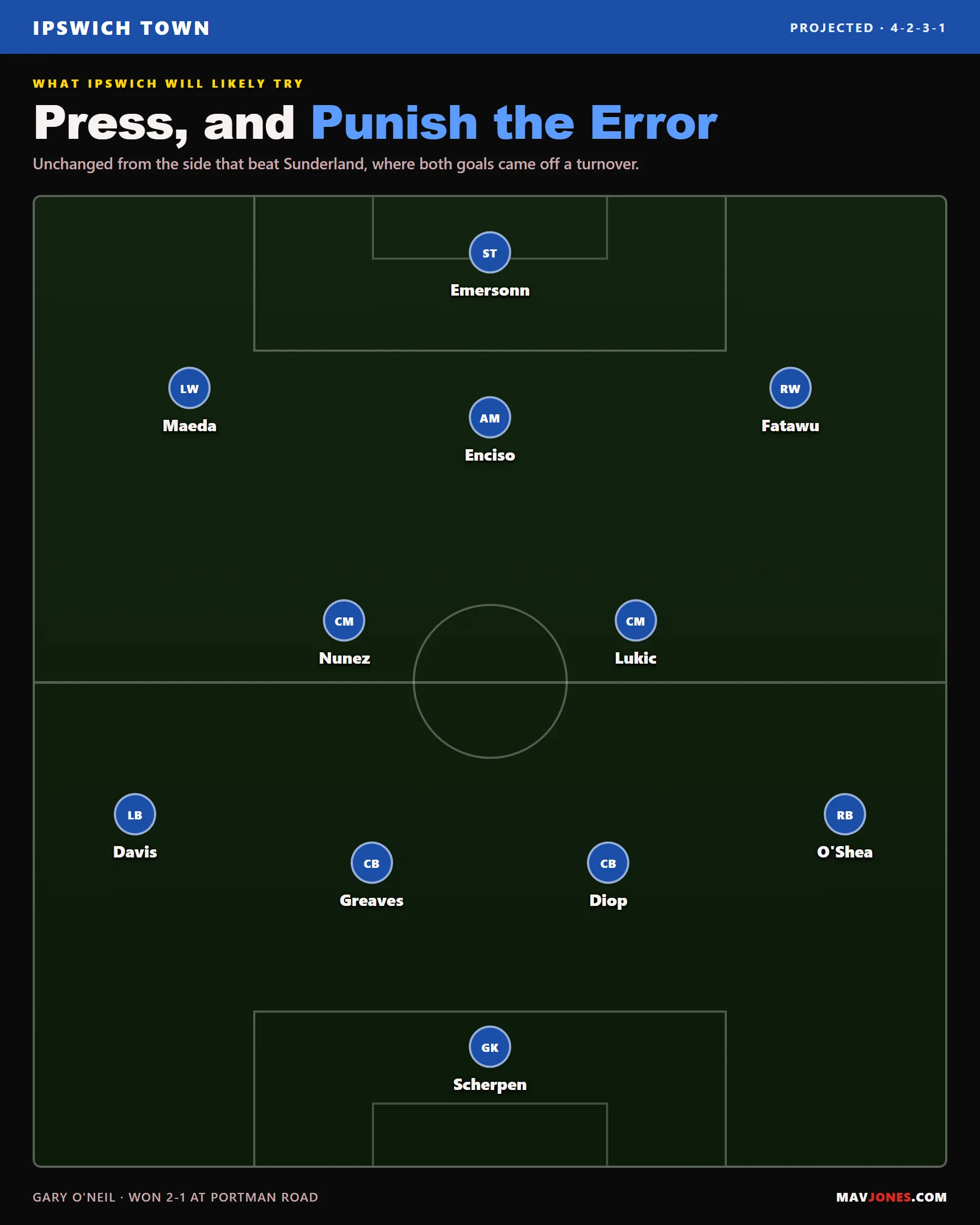
O’Neil has no reason to change a winning side in his second match. Enciso is the one to watch, because he did not score and still decided the game. Jack Clarke has a case after the winner, but he was effective precisely as a fresh runner at a tiring defence, and O’Neil may prefer to keep that. Expect the same aggression on United’s first pass, and Fatawu and Maeda holding width to stop United’s full-backs stepping in.
United (4-2-3-1): Lammens; Mazraoui, Maguire, Martinez, Shaw; Mainoo, Santos; Mbeumo, Fernandes, Rashford; Sesko.
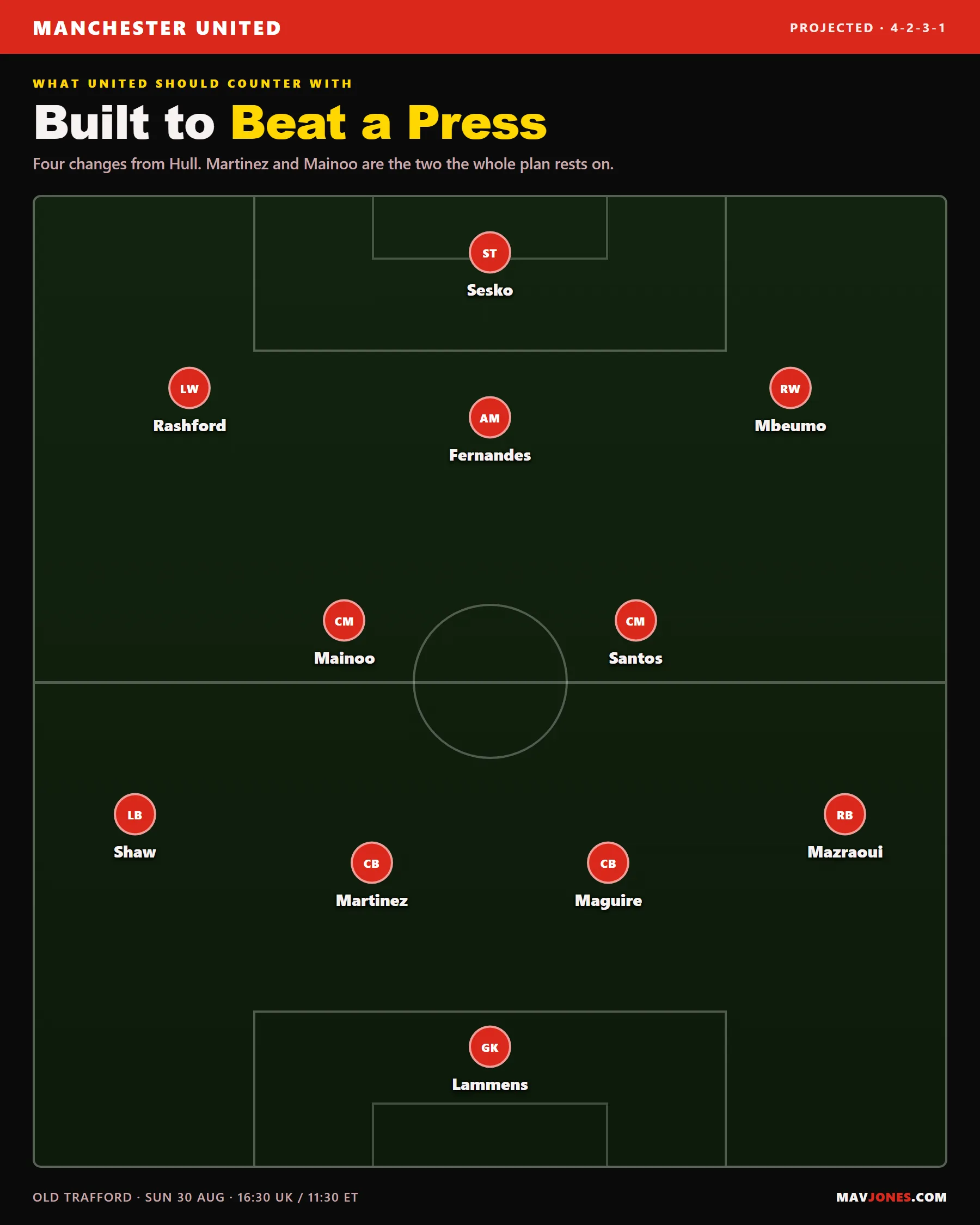
Four changes from Hull. Martinez for Heaven gives United a centre-back who can beat the first line of a press, and keeps Maguire’s aerial presence for the set pieces Ipswich will still take. Sesko for Cunha turns the false nine into a runner, because Ipswich’s line will be higher than Hull’s ever was. Rashford for Dorgu on the left rewards the only United player who changed the game on Saturday.
Cunha stays a genuine option from the bench, and a useful one. If Ipswich concede the opening goal and drop into a block, the false nine becomes the right answer again inside twenty minutes.
The pivot is the change that matters most, and it is the one that will be least popular. Andrey Santos and Tielemans started together for the first time on Saturday, having gone three consecutive pre-season matches without sharing a pitch. Hull won 50 duels to United’s 35 and 11 tackles to 4. A midfield that loses the physical contest by that margin has not been unlucky.
Kobbie Mainoo comes in for Tielemans. It was a foul by Tielemans on Slater that gave Hull the free-kick Mendy headed in, so the £35m release-clause signing was the last United player to touch the sequence that ended the game. Carrick reached his own verdict quickly enough: Tielemans was the first outfield player he removed, on 67 minutes, with United chasing two goals.
The deeper reason is profile. Tielemans is at his best in a match his side controls, dictating from deep with time on the ball, and Sunday is unlikely to be that match. Ipswich will hunt the first pass. The pivot’s job stops being progression and becomes something narrower: give the centre-backs an option that does not turn into an interception.
That is Mainoo’s single best quality. He is the finest receiver on the half-turn in this squad, and Carrick knows it, because Mainoo went from a substitute under Amorim to an ever-present the moment Carrick took over and signed a five-year deal in April on the back of it. Santos stays alongside him as the more mobile of Saturday’s two, and the more willing carrier.
Put that pair in front of Martinez and United have their three most press-resistant players occupying the exact positions Ipswich intend to attack. Sunderland’s centre-backs had nowhere safe to play on Saturday, and it cost them both goals.
What this analysis cannot tell you
One match each, and one of them United spent chasing. Ninety minutes cannot separate a marking problem from a bad morning, and 1.81 xG against a side protecting a two-goal lead is worth less than the same number at 0-0. Ipswich’s press has been tested by a Sunderland team making its own errors, which is not the same as being tested by a good one.
So the reading stays narrow. United’s attack functioned and their set-piece defending did not, and Ipswich have shown one clear way they intend to score.
Sunday
Old Trafford, 30 August, 16:30 UK and 11:30 in the morning Eastern. First home game of the season.
Two questions get answered in ninety minutes, and they are not the same question. Does the first Ipswich corner look any different from the first Hull corner? And when Enciso presses Maguire on the halfway line, does United’s centre-back have somewhere to put it?
Sources: Match data via the Premier League, Opta, ESPN and StatMuse. Line-ups as confirmed on the day. Set-piece and corner share figures via Opta Analyst and premierleague.com. Ipswich goal sequences cross-checked against Sky Sports and ESPN. Projected line-ups are this site’s own, based on Saturday’s selections and publicly reported fitness. Accurate as of 23 August 2026.