📅 August 26, 2026
From a Hut in Douala to the No.20 Shirt: The Carlos Baleba Story
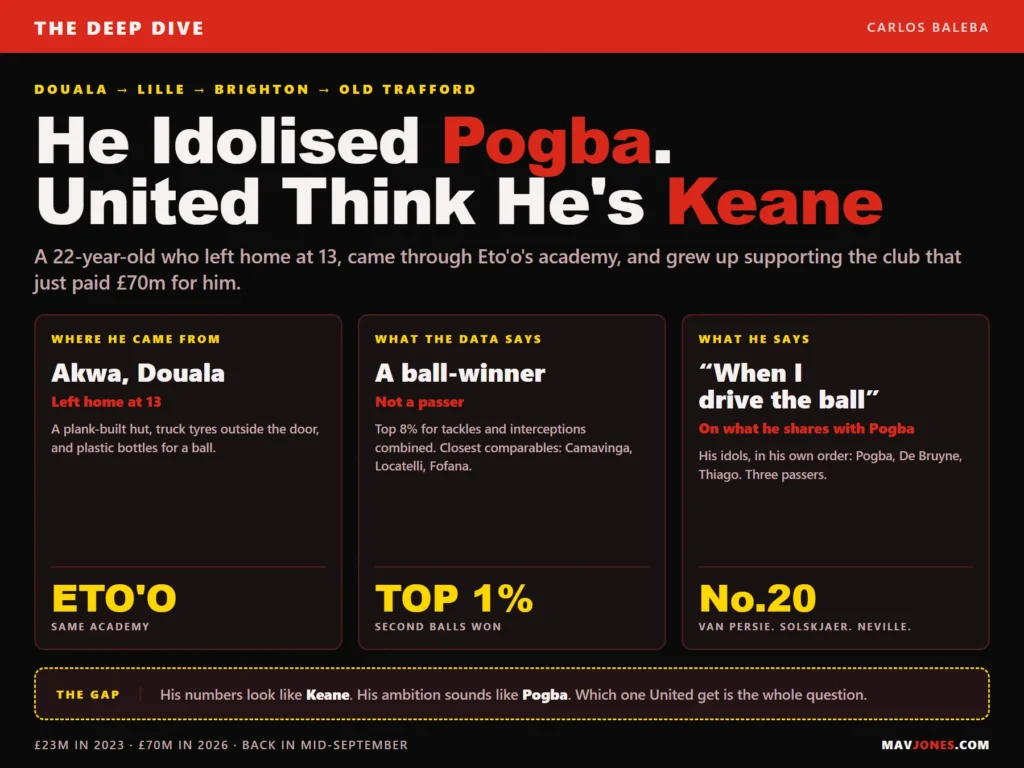
Manchester United have just spent £70m on a 22-year-old who grew up supporting them, in a plank-built hut in Douala with truck tyres outside the door, kicking plastic bottles down the street because there wasn’t a ball.
They’ve signed him to play the position occupied by the man he idolised. And inside Old Trafford they’re comparing him to somebody else entirely.
That gap is worth understanding, because it’s the whole question about Carlos Baleba.
Akwa, and a father who’d already done it
Carlos Noom Quomah Baleba was born on 4 January 2004 in Douala, Cameroon’s largest city, and raised in the Akwa neighbourhood. He’s of Bassa descent and holds both Cameroonian and French citizenship through his parents.
His father was a professional footballer, with spells in Cameroon and South Africa. His mother is a teacher. That combination shows up in almost every account of him: a father who taught him what the game demands, a mother who insisted the horizon was further away than the street.
The football itself started at Futur Soccer FC in Douala. At 13 he left home for the École de Football des Brasseries du Cameroun, the academy that produced Samuel Eto’o. That is the single most important line in his biography. It’s not a boy being spotted, it’s a boy being sent, at an age when most children have not left their own postcode.
Lille got him first, and barely got to keep him
Baleba joined Lille in January 2022 and made just 23 first-team appearances. His senior debut came barely twelve months before he left.
Brighton signed him in August 2023 for €27m, about £23.2m, on a five-year deal. The context matters: Brighton had just sold Alexis Mac Allister to Liverpool and Moisés Caicedo to Chelsea in the same window, and needed to refill a midfield they’d stripped for profit.
He also walked a path the club had used before. Yves Bissouma made the same Lille-to-Brighton move in 2018, and Brighton’s recruitment has a long habit of buying French-league midfielders a season before anyone else notices.
Roberto De Zerbi, then the head coach, was blunt about why: “Carlos is a very good player. He’s very young but a specific player for our style. He will be the future of the club.”
Three seasons on the south coast built a very specific player
112 appearances across three seasons, and a genuine upward curve rather than an instant one. He played 34 times in his first year with 31 Premier League starts, then became a fixture, and won Brighton’s Young Player of the Season in 2024/25.
The player they developed is very specific, and the numbers say so plainly. Last season: 37 tackles, 29 interceptions, six blocks, ranking in the top eight per cent of the league for combined tackles and interceptions.
And the number that has followed him into every scouting note: he ranks in the top one per cent of the Premier League for second balls won.
That is not a passer’s profile. It’s a player who wins possession in contested, messy situations and then carries it away in long strides. His closest statistical comparisons in Europe were Eduardo Camavinga, Manuel Locatelli and Youssouf Fofana. All ball-winners. None of them playmakers.
Cameroon, and a tournament that changed his standing
He made his senior international debut on 8 June 2024, starting in central midfield in a 4-1 World Cup qualifying win over Cape Verde.
AFCON 2025 in Morocco was his first tournament, and he arrived as a squad player. An absence of established midfielders opened a door, he took it, and he ended up permanently installed in the Indomitable Lions’ midfield. He was man of the match in the last-16 win over South Africa.
One African outlet nicknamed him “the vacuum cleaner” during that run, which tells you how he’s read on his own continent. Not as a creator. As the man who cleans up.
The Pogba problem
Here’s where it gets interesting, and where United fans should pay attention.
Baleba grew up supporting Manchester United. In his first interview after signing he said it flatly: “When I was younger, my football idol was Paul Pogba.” He listed his midfield idols in order. Pogba first. Kevin De Bruyne second. Thiago Alcântara third.
Asked what he has in common with Pogba, his answer was three words: “When I drive the ball.”
He’s also said, more than once, that he wants to be the best midfielder in the world, and named Rodri as the current standard: “Rodri is the best player in the world at the moment. He’s won the Ballon d’Or and I’m still learning from him.”
So the player’s self-image runs Pogba, De Bruyne, Thiago, Rodri. Three of those four are passers. The data says he is not one.
And Pogba, specifically, is the most loaded reference point available at this club. United signed the most expensive midfielder in the world in 2016 to solve central midfield, spent six years failing to build a team that suited him, and are still recruiting for the hole he left. The kid who idolised him has now been bought to fill it.
The Keane pitch, and why it is a different player
Internally, United are not selling Baleba as Pogba. Senior figures at the club reportedly believe they’ve signed someone who can have the same impact Roy Keane once had.
The recruitment work behind it was long. Christopher Vivell and head of senior scouting Kyle Macauley spent months watching him on the south coast and working through video, which is the same patience that got the fee down from Brighton’s original £120m ask to £65m plus add-ons.
Keane himself has weighed in, calling Baleba “fantastic” while making clear he isn’t convinced United’s rebuild makes them title challengers.
But Keane and Pogba are not the same job. Keane was the tempo, the aggression and the standard-setting, a player whose value was in what he prevented and demanded. Pogba was expression, risk and the long diagonal. Baleba’s numbers look like the first man. Baleba’s stated ambition looks like the second.
Which one United end up with depends on what Michael Carrick asks him to be, and on whether a 22-year-old who wants to be Rodri is content being the one who wins the ball so Bruno Fernandes can use it.
The number is its own kind of statement
He’ll wear No. 20, inherited from Diogo Dalot, who moved to No. 2 after last season.
It’s a shirt with a specific history at this club. Robin van Persie wore it. Ole Gunnar Solskjær wore it from 1996 to 2008. Gary Neville had it during the 1995/96 double.
None of them were midfield generals. All of them won things. Read into that what you like, but nobody handed a 22-year-old defensive midfielder that number by accident.
What none of this can tell you yet
He has never played for this manager, in this system, or alongside Bruno Fernandes, Andrey Santos or Youri Tielemans. The four of them have not shared a pitch.
Tackles and interceptions are also partly a product of how much your side defends. Brighton had less of the ball than United will, and a midfielder in a team that defends more will always post bigger defensive numbers than the same player in a team that dominates. The second-ball ranking survives that objection better than the raw tackle count does, but it’s worth knowing before anyone projects the numbers forward.
And he’s injured. An ankle problem picked up in pre-season means he isn’t expected back until the middle of September, so he misses Ipswich and he misses Everton.
There’s one more thing, and it’s slightly awkward given everything above. Baleba has said he hates being compared to other players. He’s spent this week being compared to two of the biggest names in the club’s history by everyone including us.
What United have bought
A 22-year-old from Akwa who left home at 13, came through Eto’o’s academy, cost Lille almost nothing and Brighton £23m, and has just been sold for three times that to the club he supported as a boy.
He’s the best second-ball winner in the league, at a club that lost its opening match of the season because nobody won a second ball in their own six-yard box. On that specific evidence, the fit is close to perfect.
The question is what happens after that. United have spent a decade signing midfielders to solve a problem that was never only about midfielders, and this one arrives carrying an idol they never got right, a comparison to a captain they’ve never replaced, and a shirt number worn by three men who won league titles.
That’s a lot to hand somebody who cannot walk properly until September.
Sources: Biography and career detail via Wikipedia, Brighton & Hove Albion and BBC Sport. Transfer terms and recruitment background via Sky Sports and ESPN. Player quotes via his first Manchester United interview and Sky Sports. International career via CAF. Performance data via the Premier League and Opta. Accurate as of 26 August 2026.