📅 August 27, 2026
How All 36 Clubs Got Into the Champions League, and Why Liverpool Are Seeded Above United
Liverpool finished fifth in the Premier League last season. They are a top seed in the Champions League. Manchester United finished third and they are not.
That isn’t a mistake, and once you understand why it happens you understand the entire competition. Here’s how all 36 clubs got in, and how they were sorted.
Thirty-six places, and where they come from
Twenty-nine clubs qualified directly. The other seven came through a qualifying tournament that started in July and finished this week.
Direct places are handed to national associations, not to clubs, and the number each country gets depends on its association coefficient, a five-year rolling measure of how its clubs have performed in Europe.
For 2026/27 that produced:
- England: 6
- Spain: 5
- Germany: 4
- Italy: 4
- France: 4
On top of the league allocations there are a handful of specific places. The reigning champions get one automatically, which this year is Paris Saint-Germain. The Europa League winners get one, which is Aston Villa. One goes to the third-placed side in the association ranked fifth by coefficient, and one goes to a domestic champion through the qualifying rounds.
The bit almost nobody understands: European Performance Spots
England normally gets four. It got six this year, and the extra ones are the newest and least understood mechanism in the competition.
Since 2024 UEFA has awarded two European Performance Spots each season. They go to the two countries whose clubs performed best across all three European competitions in the season just finished, measured on a one-year coefficient rather than the usual five-year one.
The maths for 2026/27, and it is not close:
- England: 258.125 points across 9 clubs = 28.680 average
- Spain: 176.750 points across 8 clubs = 22.093 average
Germany finished third and missed out.
The spot doesn’t go to the club that earned it. It goes to the highest-placed side in that country that hadn’t already qualified. In England that was Liverpool in fifth. In Spain it was Real Betis, also fifth.
So Liverpool are in this competition because of what Arsenal, Chelsea, Tottenham and the rest did in Europe last season, not because of where Liverpool finished. That is the system working exactly as designed, and it is why a fifth-placed team can end up a top seed.
The seven who had to earn it
Fifty-two clubs entered qualifying for the remaining seven places, and they were split down a line that matters.
The Champions Path (42 clubs) is for domestic league winners who don’t get a direct place. They’re champions of smaller associations, and they play each other.
The League Path (10 clubs) is for runners-up, third and fourth-placed sides from bigger leagues who fell short of a direct spot.
Keeping them apart is deliberate. Without it, the champions of Norway or Slovakia would be knocked out every year by the fourth-placed team from a wealthy league, and it’d stop being a competition for champions at all.
The Champions Path ran through four rounds: 28 clubs in the first qualifying round, 24 in the second, 12 in the third, and 10 in the play-off. Five Champions Path winners and two League Path winners made it through to join the 29.
How the coefficient is actually calculated
This is the number that decides everything, and it is less mysterious than people assume.
A club’s coefficient is the sum of its season coefficients over the last five seasons. Every match in the league phase and knockout rounds of any of the three European competitions earns points. Each summer the oldest season drops off and the newest is added.
There is a floor. If a club’s own five-year total is lower than 20% of its association’s five-year coefficient, it gets the association figure instead. That protects clubs from strong leagues who have been absent from Europe, and it is why a big club returning after a gap is not seeded as low as its own record would suggest.
Manchester United’s is 76.500, which put them in Pot 2. Some of that was earned by a squad that no longer exists. Coefficients measure a club’s last five years, not its current form, and there’s no mechanism anywhere in the system that asks how good you are right now.
One thing worth clearing up: UEFA also keeps a ten-year revenue coefficient, but that exists purely to divide prize money. It doesn’t affect seeding, pots or access.
Four pots, and what the draw does with them
The 36 are ranked by club coefficient and split into four pots of nine. The holders are automatically top of Pot 1 regardless of their number, which this year means PSG.
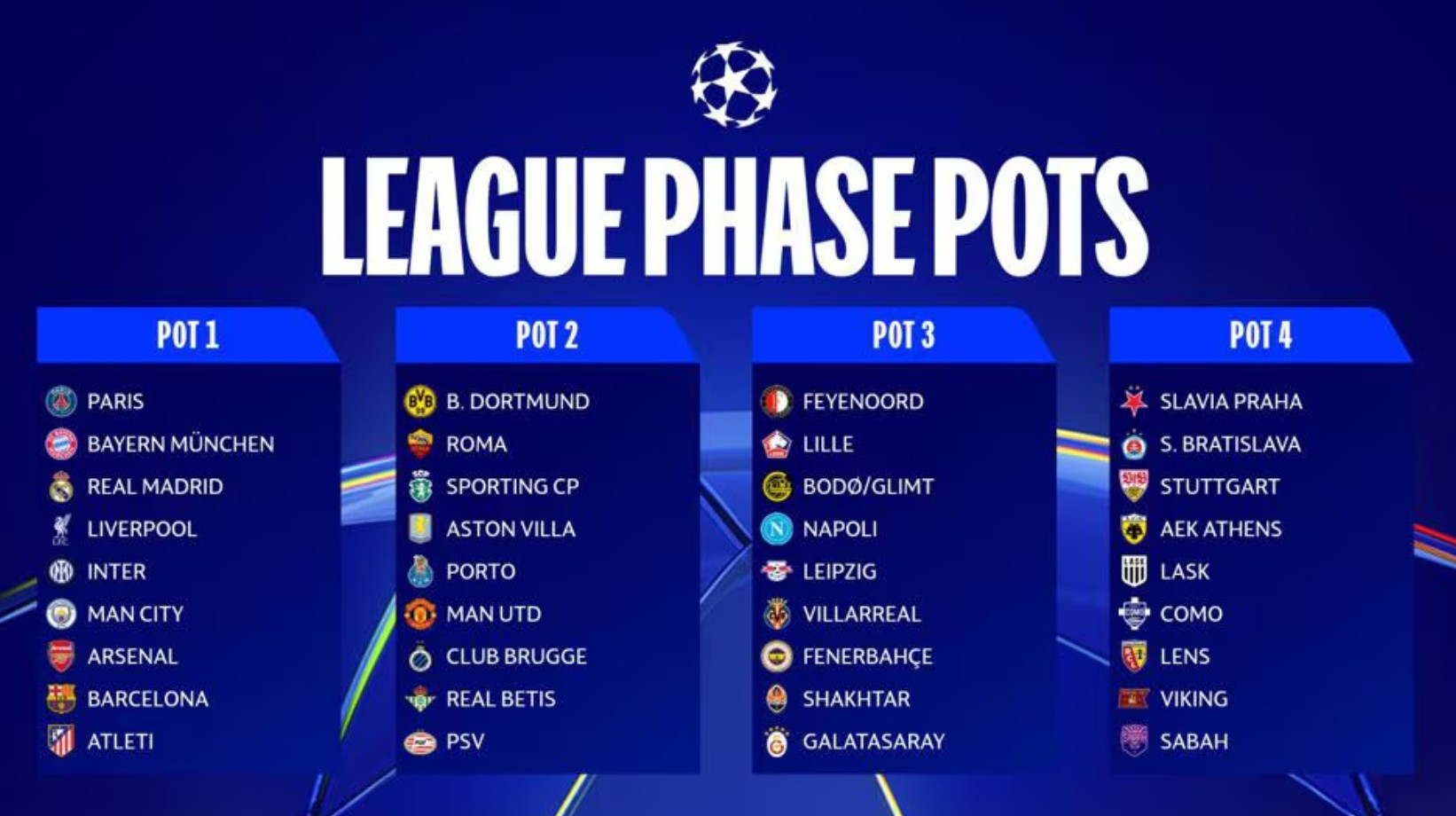
Two things in that graphic are worth pausing on. Liverpool are a top seed having finished fifth, for the reasons above. And Fenerbahçe are in Pot 3, which means United could be drawn against the club that just triggered their sell-on clause by signing Mason Greenwood from Marseille.
Every club then plays eight matches: two opponents from each pot, one at home and one away. There are no groups. All 36 go into a single table.
The draw itself, at the Grimaldi Forum in Monaco at 12:00 noon ET on Thursday, is a hybrid that surprises people who watch it for the first time. Each club is drawn by hand from a physical bowl. Then a guest presses a button and software generates all eight of that club’s opponents at once, including which four are at home. A human draws the name. A computer builds the fixtures.
Two rules constrain it. Clubs from the same country cannot be drawn together, and no club faces more than two opponents from any single other country.
What it means for United
Those two rules are why United’s draw is harder than their pot suggests.
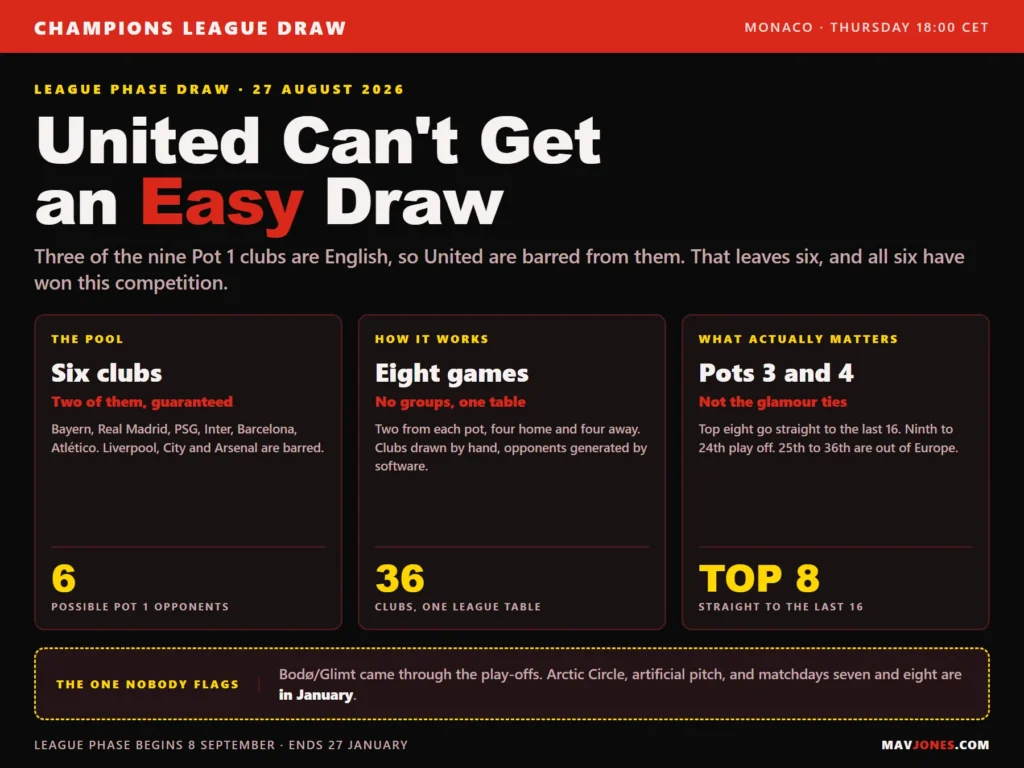
Pot 1 contains nine clubs and three of them are English. Liverpool, Manchester City and Arsenal are all barred. That leaves United’s two Pot 1 opponents to come from a pool of exactly six: Bayern Munich, Real Madrid, PSG, Inter, Barcelona and Atlético Madrid.
Every one of them has won this competition. There’s no soft option in that bowl, and it’s a direct consequence of England having six entrants rather than four.
The country cap cuts the other way, though. With Real Madrid, Barcelona and Atlético in Pot 1, Betis in Pot 2 and Villarreal in Pot 3, United could theoretically be handed a very Spanish autumn. The two-per-country limit stops it.
What this system cannot do
It can’t measure current strength, and it doesn’t try to. Everything is historical: five years for club seeding, five years for association places, one year for the performance spots. A club that has rebuilt brilliantly over one summer is seeded on what it did in 2021.
It also compounds. Strong associations get more places, more places mean more matches, more matches mean more coefficient points, and more points mean more places next year. The European Performance Spots accelerate that, because they hand extra entries to countries that were already sending the most clubs.
Whether that’s a problem depends on what you think the competition is for, and reasonable people disagree.
Thursday
Thirty-six clubs, sorted by what they did over five years, drawn by a machine, into a table that will not resolve until 27 January.
United will get two of six European heavyweights and six other clubs nobody will pay much attention to on the night. Given the top eight go straight to the last 16 and 25th to 36th are eliminated from Europe entirely, it is those six that will decide their season.
Sources: Places, format and qualifying structure via UEFA. European Performance Spot allocation and coefficient figures via UEFA. Coefficient methodology via UEFA’s published rankings explainer. Association allocations and pot composition via Sky Sports, ESPN and beIN Sports. Accurate as of 27 August 2026, before the draw.