📅 August 19, 2026
Ferguson Didn’t Haggle, He Decided: How United Transfers Changed
Watch this on TikTok The video side of Mav Jones. Follow @mavjonesdotcom. ▶ Follow on TikTok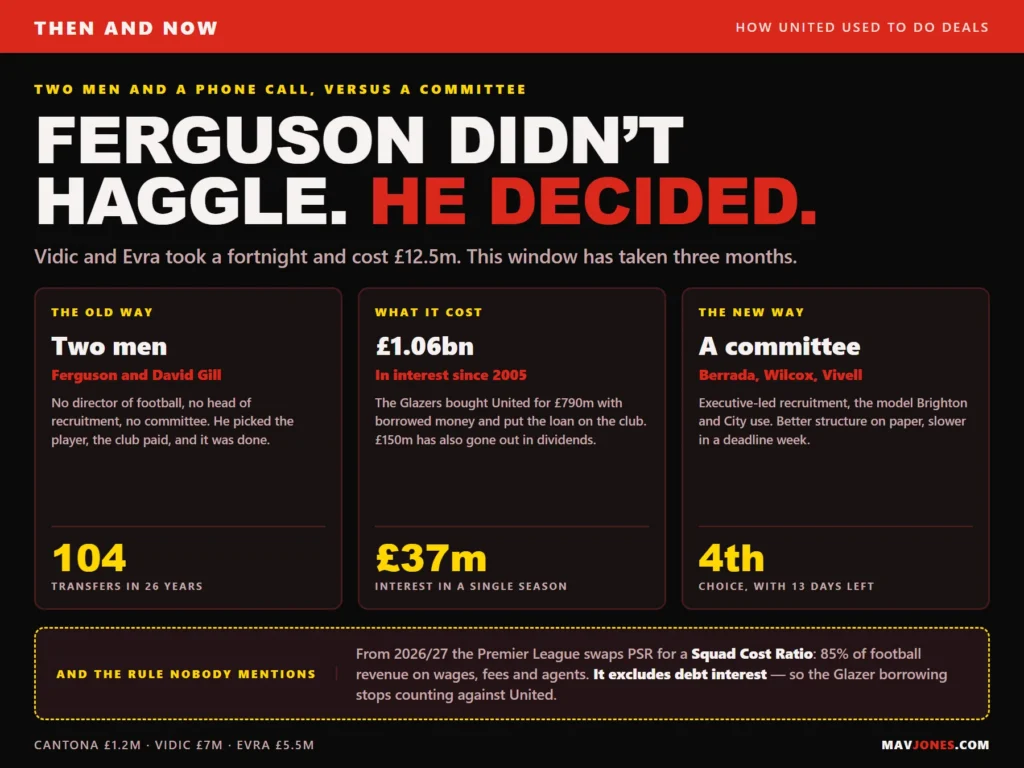
Manchester United have spent this week haggling with Brighton over the structure of a fee for a midfielder who can’t currently play. Personal terms were agreed days ago. The contract is drawn up. What remains is a gap between two valuations, negotiated through a recruitment committee, thirteen days from a deadline.
In January 2006 Alex Ferguson signed Nemanja Vidic and Patrice Evra inside a fortnight for a combined £12.5m. Between them they won fifteen major trophies.
What actually changed is more interesting than the easy answer, which is that United used to be good at this and now aren’t.
How it worked under Ferguson
The structure was two men.
Ferguson decided who United signed. David Gill, chief executive from 2003, executed it. That was the whole apparatus. No director of football, no head of recruitment, no committee, no layer of analysts signing off on a profile. A manager with total authority and a chief executive who trusted him.
The speed followed from the structure. When one person decides, a deal takes as long as a phone call and a fee negotiation. When a decision runs through a technical director, a head of recruitment, a data department and a chief executive, it takes as long as the slowest link.
Ferguson made 104 transfers across his 26 years. The hit rate wasn’t perfect, and anyone who watched Bebe or Kleberson can tell you that. But the good ones were extraordinary, and the pattern in them is instructive.
He wasn’t a bargain hunter, and he wasn’t a big spender. He was both
The romantic version says Ferguson found gems while modern United overpay. That’s half right.
The bargains were real. Eric Cantona cost £1.2m from Leeds in 1992 and won four titles in five seasons. Vidic cost £7m, Evra £5.5m. Denis Irwin, Ole Gunnar Solskjaer, Peter Schmeichel, Edwin van der Sar and Park Ji-sung all arrived for a fraction of what they returned.
But the other half matters more. Ferguson broke the British transfer record five times, for Roy Keane, Andy Cole, Ruud van Nistelrooy, Juan Sebastian Veron and Rio Ferdinand. Ferdinand cost a British record €46.9m, around £29m, in 2002. Wayne Rooney arrived in 2004 for the highest fee ever paid anywhere for a player under 20. Robin van Persie cost £24m at 29 and won the league in his first season.
So the Ferguson method wasn’t thrift. It was decisiveness. He identified the player he wanted and United paid what it took, quickly, and largely without public negotiation. When he didn’t rate the market he simply refused to buy, which is what produced the famous line in January 2010 after Cristiano Ronaldo was sold: he saw “no value” in the market and declined to reinvest the money.
Try to imagine a United manager saying that today.
What changed, part one: the debt
In June 2005 the Glazer family bought Manchester United for £790m in a leveraged buyout, which means the money was borrowed against the club, and the club rather than the buyer carries the loan.
The number that follows is the single most important fact in modern United history. Across roughly twenty years since, United’s net interest cost on that debt has reached £1.06 billion, according to football finance analyst Kieran Maguire. In one season alone the club paid £37m in interest. The family have also taken more than £150m in dividends, and net debt has passed £1bn.
A billion pounds is fifteen Vidics and Evras. It’s more than United’s entire gross spend this summer, several times over.
Ferguson won titles in the first eight years of that ownership, which gets used to argue the debt didn’t matter. What it shows is that he was good enough to paper over it for a while. The bill didn’t disappear. It just came due after he left.
What changed, part two: everyone else got rich
The other half of the story has nothing to do with United at all.
When Ferguson signed Cantona for £1.2m, English football had just launched the Premier League. Television money since then has multiplied to a degree that makes those fees look like a different sport. The Bosman ruling in 1995 handed players freedom of movement at contract end, which shifted power decisively from clubs to players and their representatives. Agent fees became a line item worth hundreds of millions across the league.
Then state ownership arrived. Ferguson competed against Chelsea from 2003 and Manchester City from 2008, and he still won, but the market he worked in stopped being one where a well-run club with good judgement could outbid anyone.
Ferdinand’s British record of £29m in 2002 wouldn’t buy a squad player now. United are currently arguing over a package worth £65m for a defensive midfielder who managed zero goals and zero assists last season. None of that’s United being uniquely foolish. It’s the market Ferguson left behind.
What changed, part three: nobody is Ferguson
This next part gets the least attention and probably matters most.
The Ferguson model had one point of failure, and it was Ferguson himself. It worked because he was an exceptional judge of a player with 26 years of accumulated authority. Hand that same absolute power to a manager who isn’t Ferguson and you get the years that followed: managers signing to their own preferences, then leaving, then the next one signing over the top.
Under INEOS, United have deliberately dismantled it. The club has moved to an executive-led structure rather than the manager-as-dictator model. Omar Berrada is chief executive, hired from Manchester City in 2024. Jason Wilcox is director of football. Christopher Vivell is head of recruitment, made permanent in February 2025. Recruitment decisions now pass through a committee of four desks.
That’s the correct structure. It’s what Brighton, Brentford and City all use, and it exists so that a squad survives a change of manager. The problem is that it’s slower, and it’s only as good as the people sitting in it.
Which is why the criticism of this window lands where it does. Nobody sensible wants Michael Carrick given Ferguson’s unchecked power. The complaint is that a committee built to make better decisions has spent the summer missing Ederson at a medical, losing Mateus Fernandes to Tottenham, missing Elliot Anderson, and arriving at its fourth choice with two weeks left. The structure is modern. The outcomes haven’t been.
The rule change nobody is talking about
One significant thing happens next season, and it happens to favour United specifically.
The Premier League is replacing Profitability and Sustainability Rules with a Squad Cost Ratio system, voted through by clubs in November 2025 and effective from 2026/27. Clubs will be able to spend up to 85% of football-related revenue on wages, transfers and agent fees combined.
The detail that matters: the new system excludes non-squad costs such as debt interest. Under the old rules, the Glazer debt counted against United’s compliance. Under the new one, it doesn’t.
United have the largest debt burden of any club in the league and one of the largest revenues. A rule that measures squad spending against revenue, while ignoring interest payments, is close to being written for them.
So which era was better at this?
Comparing them honestly is harder than it looks.
Ferguson operated with total authority, in a cheaper market, against fewer rich rivals, with an eye for a player nobody has replicated. He also wasted money on plenty of signings, and he did it before a billion pounds of interest had been drawn out of the club.
The current structure is more professional, better resourced and less dependent on one man’s instinct. It’s also slower, more cautious, and this summer it’s been reactive rather than decisive.
What actually connects the eras is a single quality, and it isn’t thrift. Ferguson’s United knew what they wanted and moved before anyone else could. This summer United have been third in line for their own targets, negotiating from a position where every club in Europe knows the deadline’s closing and the squad is short.
Vidic and Evra took a fortnight in January and cost £12.5m. The current window has taken three months and produced two senior signings, with a third being argued over. Money isn’t the difference. Certainty is.
Hull City away, Saturday, 12:30 UK and 7:30 in the morning Eastern. Luke Shaw starts at left-back, because there’s nobody else, and there hasn’t been all summer.
Source: 90min — The Glazer family has cost Manchester United more than £1bn