📅 August 20, 2026
Who Actually Runs Manchester United? INEOS, the Glazers and the Four Desks
Watch this on TikTok The video side of Mav Jones. Follow @mavjonesdotcom. ▶ Follow on TikTok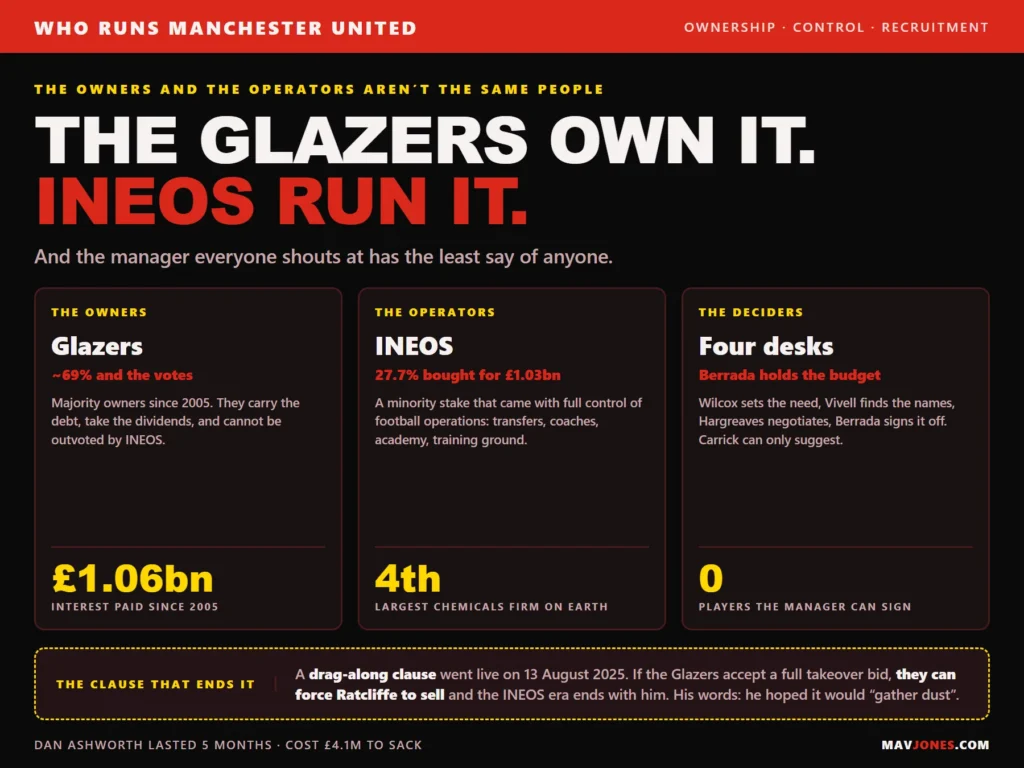
When United miss out on a midfielder, or put ticket prices up again, or spend £65m on a player who scored nothing last season, the reasonable question is: who decided that?
The answer is complicated, because at Manchester United the people who own the club and the people who run it aren’t the same people.
The split at the top
The Glazer family still own roughly 69% of Manchester United, including the voting rights. They remain the majority owners, and they’ve been the majority owners since 2005.
Sir Jim Ratcliffe’s INEOS bought 27.7% in February 2024 for £1.03 billion, since nudged up to around 28.9%. That’s a minority stake. What came with it is the part that matters: INEOS runs football operations. Transfers, coaching appointments, the academy, the training ground.
So the Glazers hold the shares and can outvote anyone. INEOS decides who plays for the team. That’s an unusual arrangement and it explains a lot of the confusion when supporters try to work out who to be angry with.
The debt sits with the Glazers’ side of the ledger. As we covered in the piece on how United’s dealmaking changed, the club has paid out £1.06 billion in net interest since the 2005 leveraged buyout. INEOS inherited that situation. They didn’t create it, and they can’t vote it away.
Who INEOS are
INEOS isn’t a sports company. It’s a chemicals manufacturer, the fourth largest in the world, founded by Ratcliffe in 1998. Annual sales of around $60 billion and more than 22,000 employees. Its products end up in everything from shower gel to medication.
Ratcliffe is worth somewhere around £17 billion, though that number has been moving in the wrong direction. The Sunday Times Rich List recorded him losing roughly £6.5 billion in a single year, and he has publicly described European chemicals as facing “extinction” under current energy costs and regulation.
That matters more than it sounds. The money funding United’s football operation comes from an industry currently under real pressure.
The wider sporting portfolio is substantial: OGC Nice in Ligue 1, FC Lausanne-Sport in Switzerland, a one-third stake in the Mercedes Formula One team, and a professional cycling team now racing as Netcompany INEOS. INEOS tried to sell Nice in 2026 and the deal collapsed, so they’ve stayed.
The Lausanne connection isn’t trivia. Two United players, Tyler Fredricson and Sekou Kone, moved there this summer. That’s the club network being used as a development pathway.
The five people who actually decide
United’s football side is now run by a small executive group rather than by a manager.
Omar Berrada, chief executive
The most powerful football person at the club. Berrada arrived in 2024 from Manchester City, where he was chief operating officer, which tells you exactly what INEOS were trying to buy: City’s operating model. He holds the budget and the final sign-off.
Jason Wilcox, director of football
An INEOS appointment, brought in as technical director and promoted when the sporting director job came free. Wilcox works with the head coach to define what the squad actually needs, and owns the overall football plan.
Christopher Vivell, director of recruitment
Formerly of RB Leipzig and Chelsea, hired on an interim basis and made permanent in February 2025. Vivell runs the scouting and data operation that turns “we need a left-sided defender with recovery pace” into a shortlist of names. He works largely out of public view.
His Leipzig background is a live factor in this window. It’s the reason United have been repeatedly linked with RB Leipzig’s David Raum.
Matt Hargreaves, director of football negotiations
The least discussed and, in a week like this one, the most relevant. Hargreaves is the man in the room haggling with Brighton over the Baleba fee.
His background is unusual for football. He’s a qualified lawyer, with a law degree from Sheffield and time at the firm Brabners, who then spent roughly 15 years at Adidas before taking this role in June 2023. He replaced Matt Judge.
So United’s deals are negotiated by a commercial lawyer rather than a football man. That’s deliberate, and it cuts both ways: harder to bounce into overpaying, potentially slower when a deadline is closing.
Sir Dave Brailsford, stepped back
The former British Cycling and Team Sky chief was the public face of the early INEOS era at Old Trafford. He has since scaled back his involvement, remaining on the football club board while concentrating on his wider job as INEOS director of sport.
How a signing gets made now
The chain runs roughly like this.
Carrick and Wilcox agree what the squad needs. Vivell produces candidates who fit that profile, using scouting and data. Hargreaves negotiates with the selling club. Berrada holds the budget and signs it off.
Four desks, and the deal moves at the speed of the slowest one.
What Carrick can and can’t do
This is the question most supporters want answered, and the short answer is that the manager cannot sign a player.
Carrick can propose names. He can specify the profile he needs. He can say whether someone suits how he wants to play. What he can’t do is decide, and that’s by design: United deliberately removed that power after a decade of managers signing to their own preferences, leaving, and being replaced by someone who signed over the top of them.
Which is why his public comment this month carried weight. “We want more, we need more, we keep looking for how we can do that” is a head coach lobbying the people above him in the only way available to him.
Berrada’s stated philosophy, in his own words
Berrada has been unusually direct about how United now operate.
In June he said: “We need to stay very focused on what we’re trying to achieve. It’s very important that you don’t let the market or the agents dictate what we should be doing.”
And: “We have a plan; we know what we can invest in, and we have to stick to that.”
You can read that two ways, and both readings are being argued right now. It’s either discipline, refusing to be pushed into £100m for a player worth £60m. Or it’s rigidity, which is how you finish a window with your fourth-choice midfielder and no left-back at all.
The Ashworth warning
Before deciding the structure is settled, look at what happened to the last man hired to run it.
Dan Ashworth lasted five months. He arrived from Newcastle as sporting director in July 2024, oversaw a £200m summer on Leny Yoro, Manuel Ugarte, Joshua Zirkzee, Matthijs de Ligt and Noussair Mazraoui, and was gone by December. Reporting at the time described a tense relationship with Ratcliffe. Sacking him cost United £4.1m. He’s now at the Football Association.
An executive structure is only as stable as the people running it, and this one has already lost its most senior football hire inside half a year.
The record so far, both sides of it
INEOS have made United leaner and less popular.
Roughly 250 staff were made redundant in a first wave, with up to 200 more announced in February 2025 as part of a transformation plan projected to save around £45m. Ambassador payments were cut. Match tickets went to a flat £66 with concessions removed mid-season. Season tickets are up 5% for 2026/27, a fourth consecutive rise, with around 600 long-standing supporters relocated to make room for hospitality.
Supporters unfurled a banner reading “your debt not ours” at a European tie, which is about as concise a summary of the grievance as you’ll get.
Against that: United are back in the Champions League, they have a permanent manager who beat every side above them last season, and the club has a functioning recruitment department for the first time in years. Whether the cuts funded that or merely coincided with it is the argument.
The clause that could end all of it
One detail is worth knowing, because it puts a limit on everything above.
The takeover agreement contains a drag-along clause. It lets the majority owners force a minority shareholder to sell if an acceptable offer arrives for the whole club. It became active on 13 August 2025, eighteen months after Ratcliffe’s investment.
In plain terms: if the Glazers ever accept a full takeover bid, they can compel Ratcliffe to sell his stake and walk away, taking the sporting control with him. Ratcliffe’s own comment on the provisions was that he hoped they would “gather dust and we never see them.”
Nobody appears close to triggering it. But the structure means INEOS run Manchester United at the pleasure of owners who could, in the right circumstances, remove them.
So who is running Manchester United?
Day to day, on anything to do with football: Omar Berrada, with Wilcox, Vivell and Hargreaves beneath him, and Ratcliffe above.
Financially, and ultimately: the Glazers, who own the majority, carry the debt, take the dividends and hold the clause that could end the INEOS era whenever a buyer appears.
And the man most supporters shout at on a Saturday, the manager, has the least power over the squad of anyone in that list.
Hull City away, Saturday, 12:30 UK and 7:30 in the morning Eastern. Carrick picks the team. Almost nothing else is his to choose.
Source: Sky Sports — Sir Jim Ratcliffe completes deal to buy Manchester United minority stake